
WTR means "Welcome to Riot." It is the first email Riot sends when an account is created, and it goes to whoever signed up. In account trading it is the strongest proof of original ownership: only the first owner has it, and whoever holds it is the person Riot support is most likely to side with in a recovery dispute.
What does "no WTR" mean?
"No WTR" in a listing means the seller cannot show the Welcome to Riot email. Usually they are not the first owner, or the original email is gone. It is not automatically a scam, but it means someone else may be able to prove ownership better than you can after you pay. Price it lower, and ask for the full owner history.
What does "WTR and receipts" mean?
It is the proof bundle sellers offer: the Welcome to Riot email, plus the purchase receipts Riot emails for every Valorant Points or skin buy. WTR shows who created the account. Receipts show the skins were paid for with a real card, not a stolen one.
If the account has changed hands before, you will also see "deleted WTR and receipt video". That is a screen recording of the previous owner deleting those emails from their inbox, so they cannot use them to claim the account back later.
Why WTR matters when you buy an account
A buddy of mine paid $120 for a "Radiant" account last year. The login worked. Three days later he got locked out, because the seller used the old recovery email to pull the account right back. Money gone, account gone, nothing he could do.
That story is the whole reason this guide exists. Buying or selling a Valorant account is not hard. Doing it without getting robbed is the hard part. Below is the plain version of how it actually works, what to check, and where people get burned.
First, the thing nobody likes to say out loud: Riot's terms of service do not allow buying, selling, or transferring accounts. You can lose the account if Riot acts on it. In practice the far more common problem is not a ban, it is the seller taking the account back after you pay. Read that twice. It shapes every step below.
What do you need to check before you buy or sell?
These few things decide whether a deal is safe. Learn them once and you will spot a bad account in seconds.
WTR email (Welcome to Riot). The very first "welcome" email Riot sends sits in the account's inbox. Only the real first owner has it. It is the strongest proof of who actually owns the account.
Purchase receipts. Every skin or Valorant Points buy sends a receipt to the email. Receipts confirm the account was not built with stolen cards.
Total spend. The real money put into the account. This is what the price should be based on, not vibes.
Owner history. If the person selling is not the first owner, there should be a clear list of who owned it before, with proof.
Deleted WTR and receipt video. If it has changed hands before, the current owner should have a screen recording showing the old emails were removed.
If you are not sure what an account is really worth, run it through the account value calculator before you talk price. Want to keep track of skins, agents, and spend in one place? The inventory builder does that for you.
How do you buy a Valorant account without getting scammed?
Here is the safe path, start to finish. Skipping steps is how people lose money.
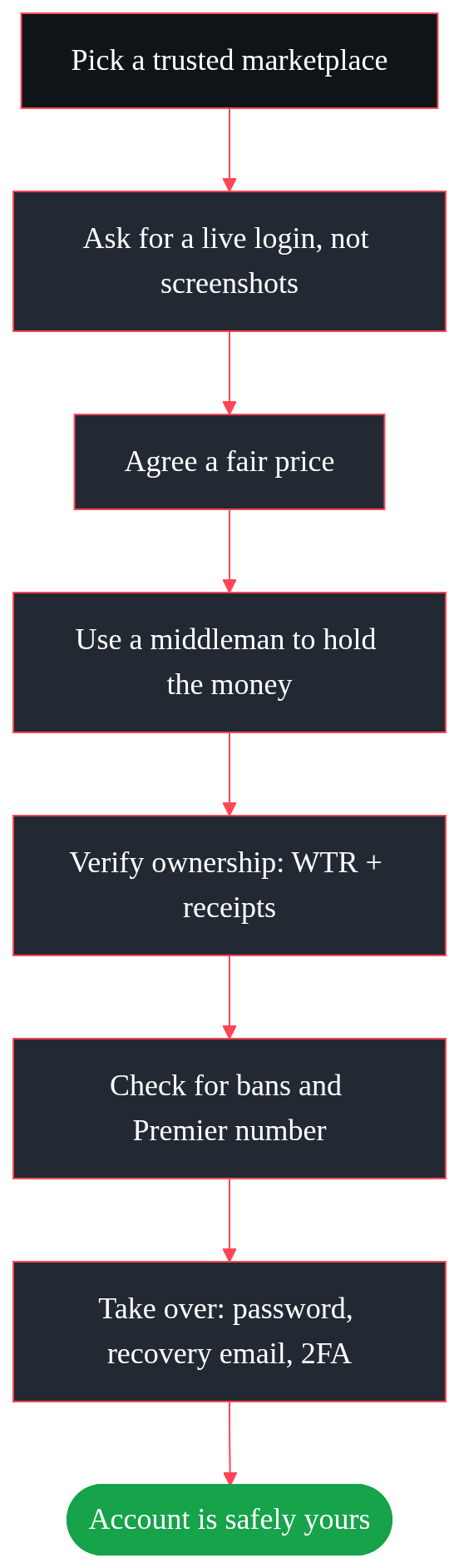
1. Start on a trusted marketplace
Search for Valorant accounts and you will drown in websites, Discord servers, and Facebook groups. Most of the small, unknown ones are fake. They post fake vouches, take your money, and block you.
Stick to marketplaces with a real track record, refund or replacement guarantees, and built-in middleman support. We keep a rated list of the ones worth trusting on the marketplaces page. When you check vouches, open the profiles leaving them. Brand new accounts all praising one seller is a setup.
2. Ask for live proof, not screenshots
A picture proves nothing. Anyone can screenshot someone else's account or pull a rank image off Google. This is the bait-and-switch: you pay for what is in the photo and receive something worse, or nothing.
Ask the seller to log in live on a screen share.
Have them open the store, the collection, and the match history while you watch.
Check the rank yourself. Deranked accounts are a common trick, where a "Radiant" turns out to be Gold once you log in.
3. Agree on a fair price
Price usually lands in one of three buckets:
Rush price. The seller wants out fast and takes 20 to 40 percent of total spend, sometimes less. Most scams live here, because a cheap account makes you drop your guard.
Fair price. The normal range, around 40 to 50 percent of total spend.
Exclusive price. Accounts with rare items like the Champions 2021 bundle or a VCT knife can go for 50 to 100 percent or more.
Check the real number with the account value calculator so you are negotiating with facts.
4. Use a middleman so nobody can run
A middleman holds the money while both sides do their part. It is the single best protection in account trading, and most trusted communities have one. Here is how it keeps both people honest:
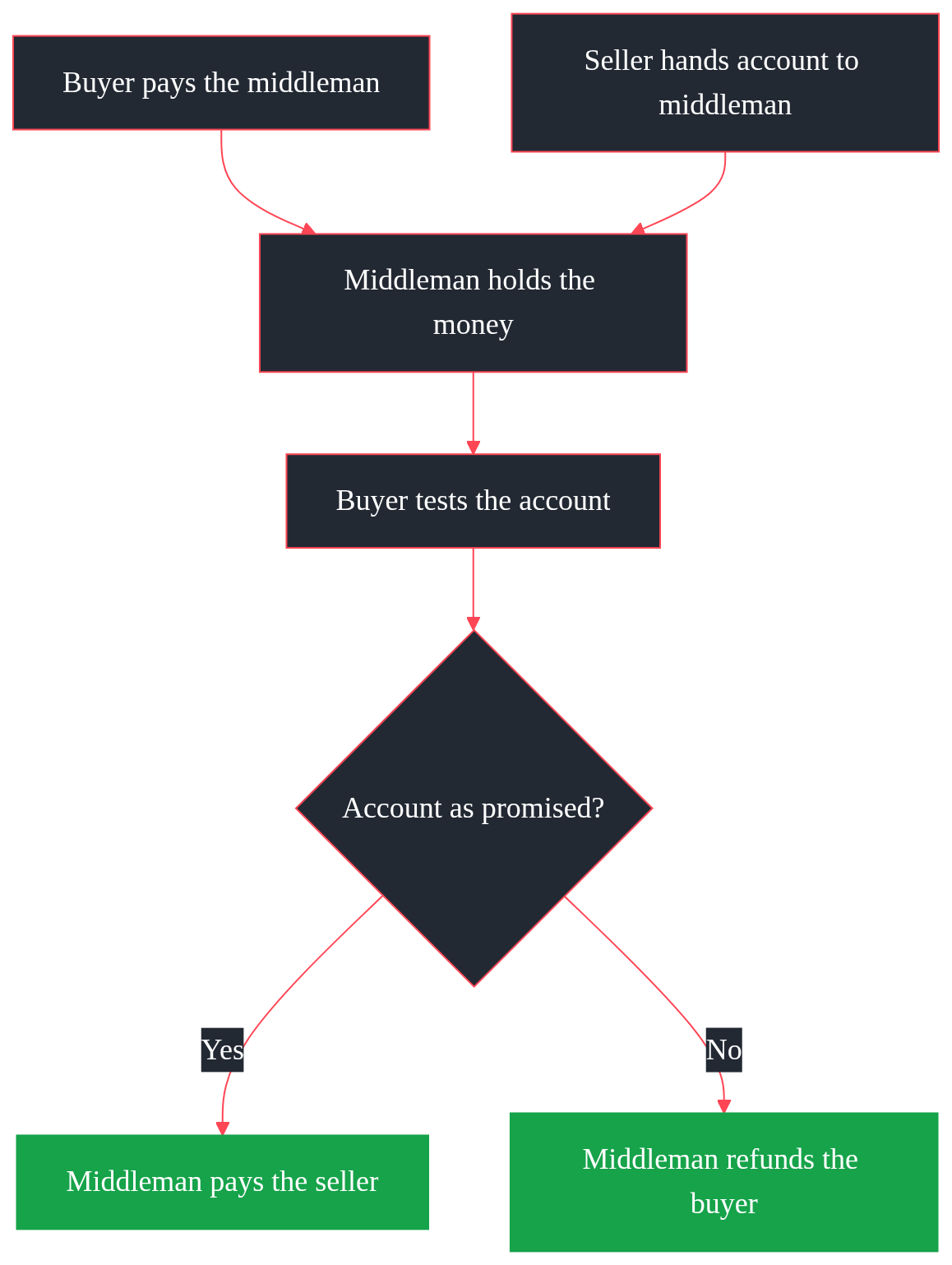
A real middleman will:
Confirm the seller is verified and not flagged as a scammer elsewhere.
Check that ownership is valid: WTR, receipts, and the account creation date.
Take the seller's government ID so the account cannot be quietly reclaimed later.
Hold your money, let you test the account, and only release payment once you say it is good.
Fees are small, usually one to five dollars depending on the account. One rule, no exceptions: never accept a middleman the seller "brings along." If the seller insists on using their own friend, walk away. The fake-buddy middleman is one of the oldest scams there is.
5. Verify ownership before money moves
This is the step that stops the recall scam, where a seller reclaims the account days later. Slow down here.
Confirm whether they are the first owner. First-owner accounts are the safest.
If not, get the previous owners list plus the deleted WTR and receipt video.
Make sure all purchase receipts exist and match the skins.
Check the account is not reported as a scammer anywhere.
If any of this feels like too much to track, that is exactly what the middleman is for. For the deeper version, see our ownership and recovery guide.
6. Check for bans and a linked Premier number
Before you hand over a cent, confirm the account has no hidden bans and no Premier phone number still attached. A leftover Premier number lets the old owner keep a foot in the door. Both are reasons to pause the deal.
7. Take full ownership the moment it is yours
The handover is not done when you log in. It is done when the old owner is locked out for good.
Change the password.
Move the recovery email to one you control.
Set up your own authenticator.
Remove any saved payment methods.
Do these in the first five minutes. This is what would have saved my friend his $120.
How do you sell a Valorant account safely?
Selling is the same trust problem flipped around. The buyer is worried about getting a fake account; you are worried about a chargeback or a buyer who tries to steal it during the "check."
List on a trusted marketplace, not a random group. Use the marketplaces page to pick one.
Know your real worth first. Run the account through the account value calculator and use the inventory builder to lay out every skin and stat cleanly for buyers.
Be honest about problems. No WTR, a lost Premier number, a community ban: say it upfront. Hidden issues are how deals blow up halfway through.
Have your proof ready: WTR, receipts, and transaction screenshots. If you are not the first owner, include the previous-owner details and the WTR deletion video.
Use a middleman here too. Show them every proof they ask for.
When the buyer tests the account, protect yourself on the login. With 2FA off, logging into the game itself will not ask for a one-time code, but logging into the Riot website to change the email will. So if someone is asking for the OTP, they are not just "checking" the account, they are trying to take it. Do not share that code until the middleman confirms the deal is closed.
One more thing for sellers: do not try anything clever after the sale, like recalling the account. The middleman has your ID. Pulling that move gets your name posted across trading communities, and you are done in this market.
Which payment method is safest?
Use PayPal (goods and services) or a credit card. Both give you a way to dispute fraud.
Never send money directly to a stranger with no platform and no middleman.
Be aware of chargeback fraud, where a buyer pays, takes the account, then reverses the payment. We break this one down in detail in the PayPal chargeback scam guide.
What are the biggest red flags?
If you see these, stop. Most scams wave at least one of these flags before they take your money.
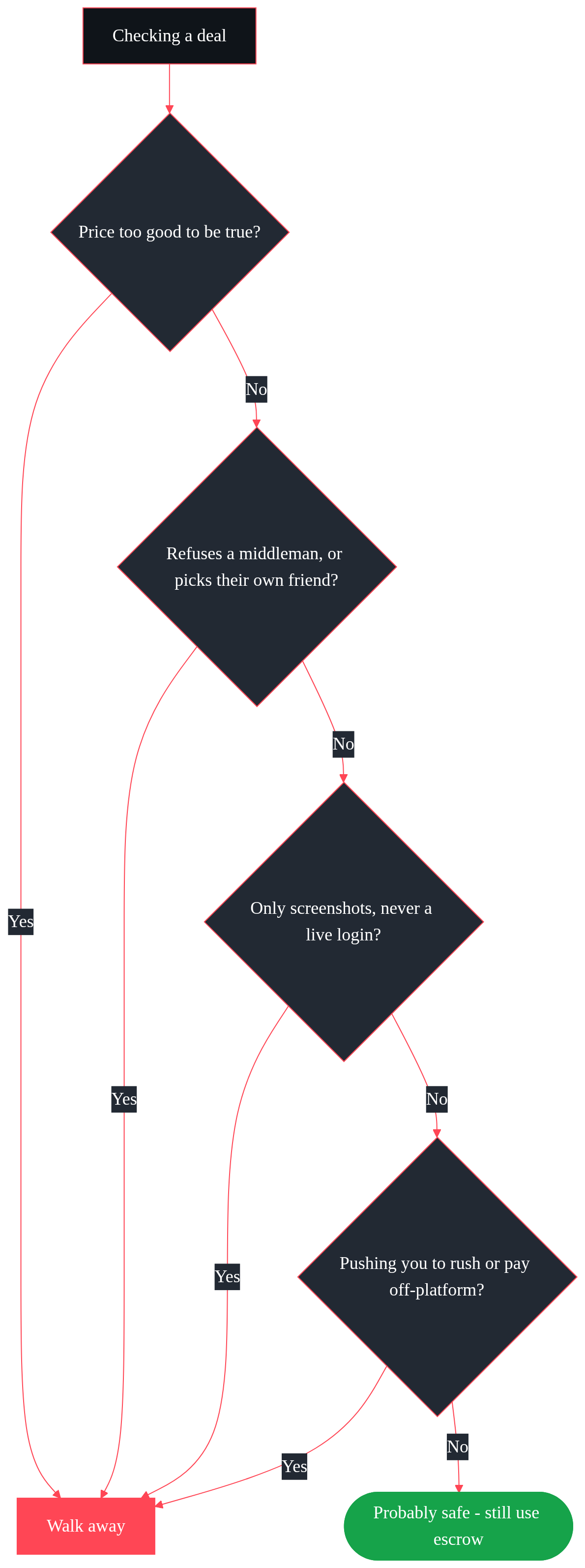
A price that is way too good for what is offered.
"Trust me" instead of a middleman, or a middleman the seller picked.
Only screenshots, never a live login.
Pressure to move fast or to pay outside the platform.
A seller who gets annoyed when you ask for the WTR, receipts, or owner history.
For real stories of how these play out, read our common Valorant account scams guide.
Quick recap before you trade
Do these five things and you avoid almost every scam in this market:
Buy or sell only on a trusted marketplace.
Price the account with real numbers using the value calculator.
Demand a live login, never just screenshots.
Use a real middleman, never the seller's friend.
The second the account is yours, change the password, recovery email, and 2FA.
More walkthroughs, scam breakdowns, and pricing help live on the guides page. Trade smart, and the account stays yours.