
Someone I know sold a stacked account for $200, got paid through PayPal, handed everything over, and felt great about it. Two weeks later PayPal yanked the money back. The buyer had filed a chargeback, kept the account, and walked away with both. My friend was out the account and the cash.
Selling a Valorant account is mostly a trust problem, just flipped around from the buyer's side. You are not worried about a fake account. You are worried about getting your account stolen during the "check," or getting paid and then having that payment reversed. This guide walks through how to sell without either of those happening.
One thing to say plainly first: Riot's terms of service do not allow selling or transferring accounts, and Riot can act on the account if it wants to. That is the rare risk. The common risk is the buyer-side scam. Everything below is built around shutting those down.
What do you need ready before you list?
Buyers pay more, and pay faster, when the account is easy to trust. Get these in order before you post anything.
Proof of ownership. The Welcome to Riot (WTR) email is the strongest one. If you are the first owner, you have it. If you bought the account, you need the previous owner details and the WTR deletion video.
Purchase receipts. Every skin and Valorant Points buy emails a receipt. Having them ready proves the account was not built on stolen cards.
The real total spend. This is what your price should be based on. Guessing leaves money on the table or scares buyers off.
A clean inventory list. Skins, agents, rank, account level, all laid out so a buyer can see what they are getting at a glance.
Two tools make this part painless. Run the account through the account value calculator so you price it on real numbers, not a hunch. Then use the inventory builder to lay out every skin, agent, and stat in one clean page you can show buyers instead of a pile of blurry screenshots.
How do you sell a Valorant account safely?
Here is the path from listing to getting paid. The order matters, so do not skip ahead.
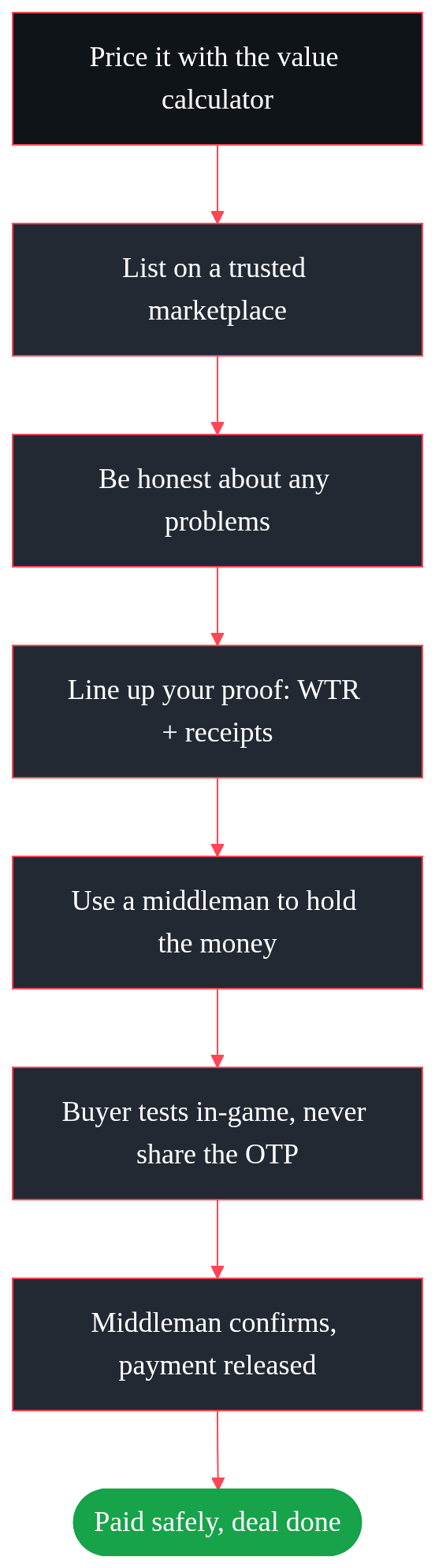
1. Price it before you post it
Set your price on the real total spend, not vibes. As a rough guide:
Rush sale, when you want out fast: around 20 to 40 percent of total spend.
Fair price, the normal range: around 40 to 50 percent.
Exclusive, with rare items like a Champions 2021 bundle or a VCT knife: 50 to 100 percent or more.
Use the account value calculator to land on a number you can defend when a buyer tries to talk you down.
2. List on a trusted marketplace
Skip random Discord servers and Facebook groups. That is where most seller scams happen, and where you have no protection if a deal goes bad. List on a marketplace with a real track record, buyer and seller guarantees, and built-in middleman support.
We keep a rated list on the marketplaces page. Pick one with escrow so the money is held safely while the buyer checks the account.
3. Be honest about any problems
Hidden issues are what blow up deals halfway through, usually after you have already shared something you should not have. Say it upfront if the account has:
No WTR email.
A lost or missing Premier number.
Any community ban or report history.
A previous owner you cannot fully document.
An honest listing sells slower but closes cleaner. A buyer who finds a problem mid-deal assumes you were hiding it, and that is when they start playing dirty.
4. Have your proof lined up
Before a buyer ever logs in, have everything a middleman might ask for sitting in one folder:
WTR email and purchase receipts.
Transaction screenshots.
If you are not the first owner: the previous-owner details and the WTR deletion video.
Ready proof signals you are not a scammer, which is half the sale.
5. Use a middleman, and never the buyer's
A middleman holds the payment while both sides do their part, then releases it once the deal is confirmed. It protects you from chargebacks and the buyer from a fake account at the same time.
Use the marketplace's own middleman, or one the community trusts.
Hand over every proof they ask for. Cooperating fully is what gets the deal verified.
Never accept a middleman the buyer "brings along." The fake-buddy middleman is one of the oldest scams there is, and it works on sellers too.
Fees are small, usually one to five dollars. If you want the full breakdown of how fake middlemen operate, read our fake middleman Discord scam guide.
6. Protect the login when the buyer tests it
This is the step where accounts get stolen, so slow down. When the buyer logs in to check the account, the danger is the one-time code (OTP).
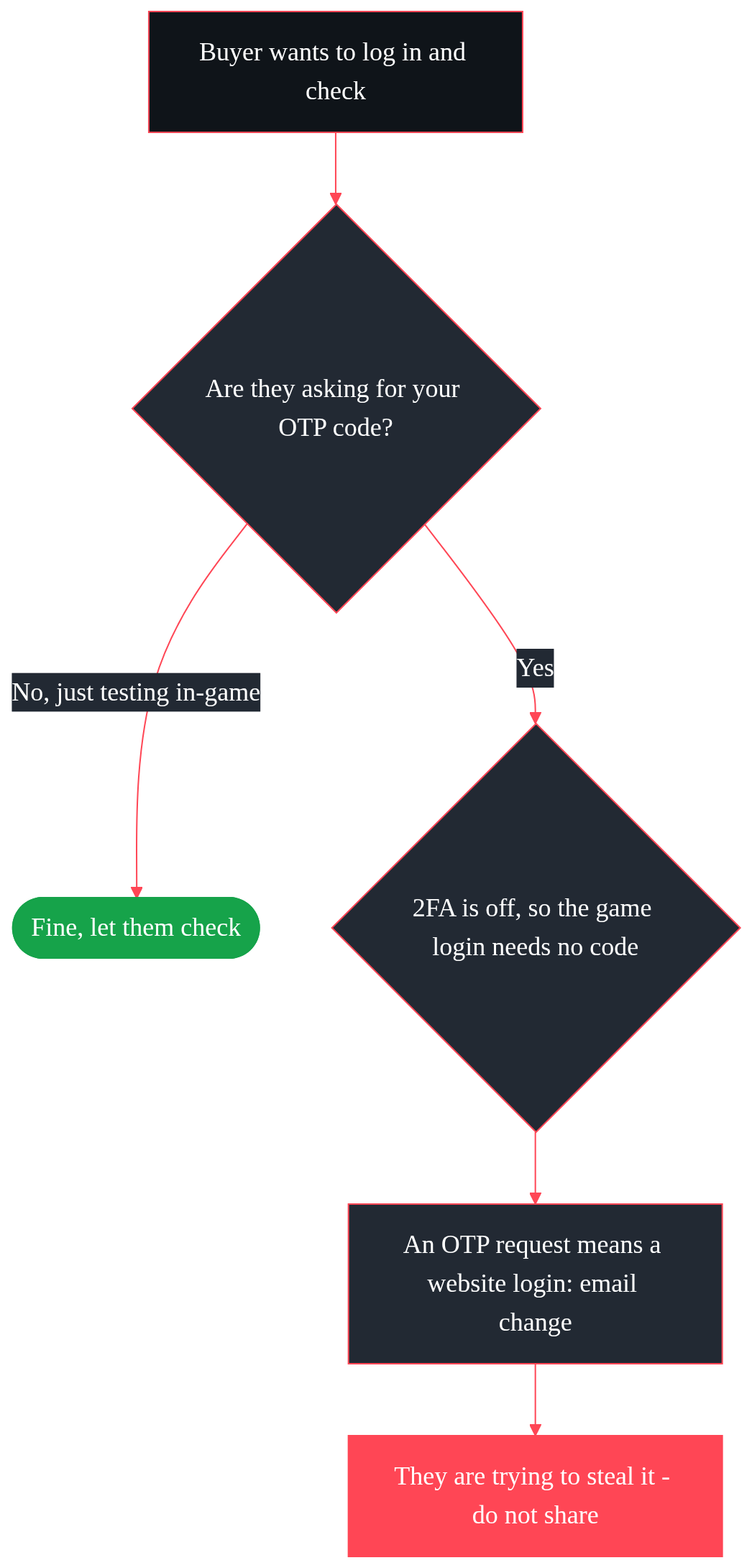
Here is the key thing to understand. With 2FA off, logging in to the game itself does not ask for an OTP. But logging in to the Riot website to change the email does. So if a buyer is asking you for that code, they are not "just checking" the account. They are trying to take it.
Do not share the OTP for any reason while the deal is open.
Let the buyer test the account in-game, not on the account settings page.
Only the middleman closing the deal moves the account over, never a code you hand a stranger.
Scammers have gotten creative here, using bots that call pretending to be Riot, and fake QR "verification" screens. If you want to see exactly how those play out, read the OTP bot scam guide and the QR code scam guide.
7. Get paid safely, then stay out of it
Once the middleman confirms the buyer is happy, the money is released to you. Two rules from here:
Take payment through the middleman or a method with fraud protection. Avoid raw transfers with no platform behind them, since that is exactly how the chargeback trick works. We break it down in the PayPal chargeback scam guide.
Do not try anything clever after the sale, like recalling the account. The middleman has your ID. Pull that move and your name gets posted across trading communities, and you are finished in this market. We cover that one in the account recall scam guide.
What are the biggest red flags for sellers?
If a buyer does any of these, slow the deal down or walk away.
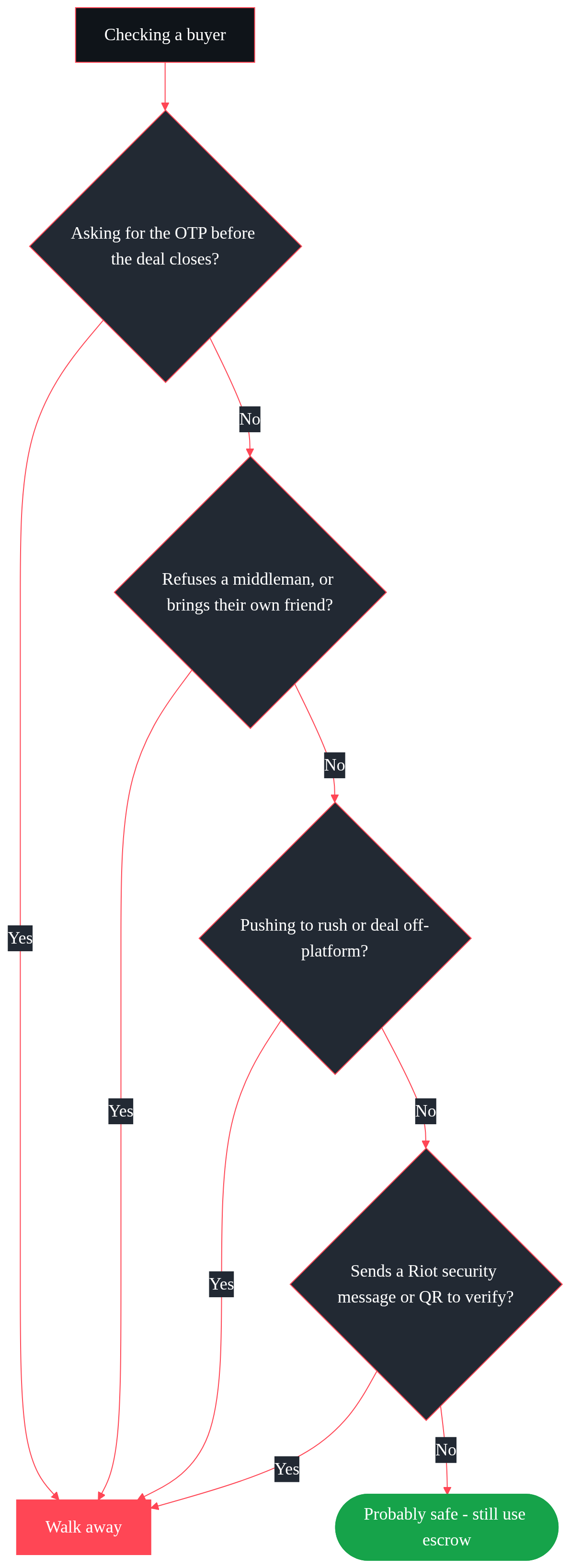
They ask for the OTP or any login code before the deal is closed.
They refuse a middleman, or insist on using their own friend.
They push you to move fast or to deal off the marketplace.
They want to pay by a method with no fraud protection and no platform behind it.
They send a "Riot security" message or a QR code to "verify" the account.
Any one of these is enough reason to pause. Most seller scams wave at least one before they strike.
Which payment method is safest for sellers?
Best: payment held and released by a trusted middleman or marketplace escrow.
Okay: PayPal goods and services or a card, knowing a determined scammer can still attempt a chargeback.
Never: direct transfer to a stranger with no platform and no middleman.
The whole reason escrow exists is the chargeback. Get the money cleared through a middleman and you close that door.
Quick recap before you sell
Do these and you avoid almost every seller scam:
Price the account on real numbers with the value calculator, and lay it out with the inventory builder.
List only on a trusted marketplace, never a random group.
Be honest about any problems before you list.
Use a real middleman, never the buyer's friend.
Never share the OTP, and only let the middleman move the account once payment is secured.
Buying instead of selling, or doing both? Our companion guide to buying Valorant accounts covers the other side of the table.
More scam breakdowns, pricing help, and account guides live on the guides page. And while you are on the site, ValoGuide also has a crosshair builder and pro player crosshairs, plus the latest Valorant leaks. Sell smart, and the only thing that changes hands is the account.